The Temple in the Old Testament was the sacred dwelling place where God's presence was known to the children of Israel. A physical house and sanctuary for worship, prayer, sacrifices, atonement, festivals (Passover, Sukkot), and pilgrimage. It symbolized the covenant between God and Israel.
It was also symbolic in the New Testament to represent Jesus himself and the believers who are the church and the dwelling place of the Holy Spirit in the body of Christ. Its desecration by idol worship in the Old Testament and then commercialism during Jesus time, which led to Jesus driving out the money changers. Established that God’s temple is holy and a place of holiness and if desecrated God will absolutely destroy it.
The Tabernacle & Solomon's Temple.
During the 40 years the children of of Israel wandered in the wilderness after the exodus. The Tabernacle was a portable tent-like sanctuary built by the Israelites according to God's detailed instructions, serving as His temporary dwelling place and as a central worship center during their wilderness wanderings. It featured an outer court for general worship and an inner tent with a "Holy Place" and the most holy place called the Holy of Holies where Ark of the Covenant was kept, symbolizing God's presence among His people.
King Solomon, the son of David built the first temple on Mount Moriah, following David's plans who had gathered the material for the first temple.
It was a magnificent permanent structure housing the Ark of the Covenant, which contained the Ten Commandments replacing the portable Tabernacle.
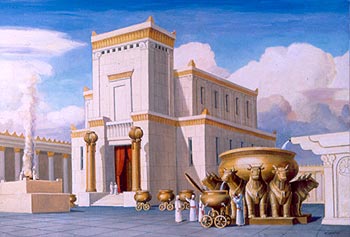
Solomon's Temple, also called the First Temple, was built in the City of David in ancient Jerusalem, which served as the central place of worship for the Israelites. It was renowned for its lavish design featuring cedar, gold and intricate carvings.
480 years after the exodus in 852BC, in the 4th year of Solomon’s reign. Solomon builds the first temple to replace the Tabernacle as God’s permanent dwelling place, I Kings 6:1.
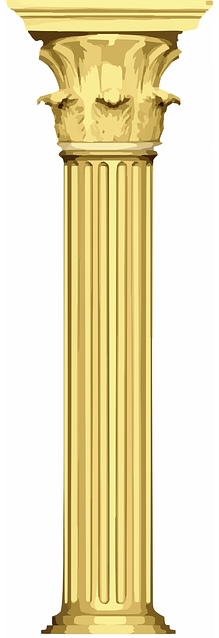
The two pillars at the entrance of the temple were named Jachin and Boaz.
The Temple was built as a place for God to dwell among His people (Exodus 25:8).
A place of holiness for God’s people to know and experience the presence of God (Shekinah) and for God’s glory to be manifest (1 Kings 8).
It became the heart of Jewish religious life, central for worship, prayer, sacrifices, confession, and for atonement receiving forgiveness of sins (Psalm 18:6, 1 Kings 8).
Solomon's temple was a grander version of the Tabernacle, featuring the Holy Place and the most holy place, the Holy of Holies where God's presence resided (1 Kings 6-8).
Described in the Bible, it featured distinct areas. A porch (Ulam), a main sanctuary (Heikal), and the Holy of Holies (Debir) for the Ark.
Constructed with pre-cut stones, cedar, cypress, and gold, with decorations of cherubim, palm trees, and flowers.
It took seven years to build, involving massive labor forces and skilled craftsmen, notably Hiram of Tyre.
The furnishings of Solomon's Temple were lavish, crafted from gold and bronze and included the great Bronze Sea (a huge basin for priests), ten Lavers (smaller basins for offerings), the Altar of Burnt Offering (bronze), the Altar of Incense (gold), ten Table(s) of Showbread (gold), ten Lamp stands (gold), the Ark of Covenant, the Mercy Seat and numerous golden vessels like snuffers, bowls, and tongs all serving symbolic functions of purification for the worship of God in the presence of God.
The Bronze Furnishings were crafted by Hiram of Tyre.
The Altar of Burnt Offering, also known as the Brazen Altar, was a large bronze-covered altar in the courtyard of the Israelite Tabernacle (and later the Temple) where priests performed sacrifices, symbolizing atonement for sin, complete surrender to God, and reconciliation with Him through the shedding of blood, ultimately pointing to Jesus Christ's sacrifice. It was made of acacia wood, overlaid with bronze and had four horns with a bronze grate inside to hold ashes and fire, which came from heaven.
It was 7.5 ft square and 4.5 ft high.
It had horns at the corners, bronze rings for carrying poles and a bronze grating inside.
It was placed in the outer court of the Tabernacle, between the entrance and the Holy Place.
The alter was used for burnt offerings, animals like bulls, sheep and goats that were completely consumed by fire, symbolizing total dedication.
The blood of the sacrificed animals was applied to the altar, signifying the atonement and payment for sin.
Fire from God would sometimes consume the offerings showing His acceptance (Leviticus 9:24).
It represented Christ's ultimate sacrifice on the cross, providing redemption and a way for humanity to approach God.
In essence, the altar was the foundational piece of worship, reminding the Israelites that sin required sacrifice and that God provided the means for forgiveness and relationship.
The Bronze Sea (or Molten Sea) was a massive circular bronze basin in the courtyard of Solomon's Temple, used by priests for ritual washing symbolizing purification before serving God. Cast by Hiram of Tyre, it held immense amounts of water and stood on twelve bronze oxen that was elaborately decorated, functioning as a larger replacement for the tabernacle's laver, representing holiness, creation, and ultimately foreshadowing the cleansing power of Christ in Christian theology.
It was made of bronze (brass), it was circular, 10 cubits wide (about 15 ft), 5 cubits high (about 7.5 ft), and 30 cubits in circumference (about 45 ft).
It rested on twelve bronze oxen, three facing each cardinal direction (north, south, east, west), symbolizing strength and the tribes of Israel.
The rim was decorated with lily-like patterns and rows of gourds.
It held vast amounts of water (thousands of baths).
Its primary function was for priests to wash their hands and feet before ministering, signifying spiritual cleansing.
It echoed the cosmic sea from creation, representing God's ordered world say some interpretations.
Its size and use stressed the importance of purity and holiness in God's presence.
In Christian thought, it prefigured the ultimate cleansing from sin provided by Jesus' sacrifice.
Ten Bronze Laver in the Tabernacle, a large bronze basin in the outer court, was for priests to wash their hands and feet before entering the sanctuary, symbolizing essential ritual cleansing and sanctification from worldly defilements after the sacrifices, serving as a "divine mirror" of God's word for daily spiritual renewal before serving God. Made from polished bronze mirrors donated by women, it represented purification and was a crucial step before approaching God's holy presence, foreshadowing Jesus' cleansing work.
It was placed in the outer court, between the Altar of Burnt Offering and the entrance to the Tabernacle itself.
It was made from polished bronze, donated by women who served at the tabernacle entrance, which functioned like mirrors.
A large basin on a stand, likely with an upper basin for hands and a lower one for feet.
Priests had to wash their hands and feet to become ritually clean before performing duties at the altar or entering the Holy Place, lest they die.
Represented ongoing purification from the grime of sacrifices and worldly defilement, a daily cleansing needed for service.
Its reflective bronze surface symbolized seeing oneself in God's Word for self-correction and revelation, linking to spiritual cleansing and holiness.
It foreshadowed the complete cleansing from sin's guilt (Altar) and the continuous sanctification (Laver) that believers receive through Jesus Christ.
Key Biblical References, Exodus 30:17-21, details the command, purpose, and requirement for priests to wash hands and feet.
Exodus 38:8 mentions its construction from women's mirrors.
The ten ornate, wheeled bronze stands (mekonot) described in 1 Kings 7 and 2 Chronicles 4, which supported large bronze basins (lavers) for ritual washing of sacrifices and priests' hands/feet in Solomon's Temple, symbolizing purity, God's glory, and the need for holiness in His presence. These elaborate stands, decorated with lions, oxen, and cherubim, were key functional and symbolic furnishings alongside the Bronze Sea and pillars, highlighting the grandeur and requirements of worship.
The main gold furnishings in the Holy Place of the Tabernacle were the Table of Showbread, the Golden Lampstand (Menorah), and the Altar of Incense, all made of wood overlaid with pure gold, representing God's provision, presence, and the prayers of His people. These items symbolized holiness, divine perfection, and the ongoing worship of God, providing light and representing intercession for Israel.
The Altar of Incense in the temple was a golden, wood-built altar in the Holy Place, used by priests daily to burn a special fragrant incense mixture (like frankincense) each morning and evening, symbolizing the prayers of God's people rising to heaven. Placed right before the veil to the Holy of Holies, its sweet smoke filled the sanctuary, representing Christ's mediation and the acceptance of prayers through sacrifice, with its horns receiving blood from sin offerings for atonement.
It was made of acacia wood, overlaid with pure gold.
It was square about 2 feet by 2 feet and 3 feet high.
It had four horns on the corners, with gold rings for carrying poles (staves).
It was placed in the Holy Place, directly in front of the veil that separated it from the Most Holy Place.
A priest burned incense every morning and evening when tending the lamps.
The rising smoke symbolized the prayers of Israel ascending to God.
The fragrance filled the sanctuary, representing Christ's covering and mediation.
Atonement was made on it yearly, the Day of Atonement and sin offering blood was applied to its horns, showing prayers are accepted through sacrifice.
In the New Testament Jesus is the Intercessor of prayer. The New Testament links the altar to Jesus' intercessory work as the ultimate High Priest.
The Book of Revelation depicts angels offering incense with the prayers of the saints on a golden altar before God's throne, fulfilling the Old Testament image.
The Table of Showbread in the Temple (and Tabernacle) was a golden table holding twelve loaves of bread, representing the twelve tribes of Israel, symbolizing God's continual provision and fellowship with His people, where priests would eat the old bread weekly and replace it with fresh loaves sprinkled with frankincense. Made of acacia wood overlaid with gold, it stood in the Holy Place and served as a perpetual offering of God's presence, a "bread of the presence," with the priests eating it as a sign of peace and communion.
It was made of Acacia wood covered in pure gold, with a gold molding around the top.
It was about 3 feet long, 1.5 feet wide, and 2.25 feet high (two cubits by one cubit by one and a half cubits).
It had gold rings and carrying poles (staves) to move it during wilderness wandering.
The Showbread were twelve loaves, made from fine flour, arranged in two piles of six.
Baked weekly by the priests from flour, with frankincense sprinkled on each row.
It represented the twelve tribes and symbolized God's covenant and sustenance for Israel, a meal of fellowship.
It was placed in the Holy Place, across from the Menorah (lampstand).
Each Sabbath, the old loaves were eaten by the priests in the holy place, replaced by new ones.
It signified God's constant presence with His people and His provision for them, with the priests' consumption symbolizing peace and communion with God.
10 golden lampstands (menorahs) in Solomon's Temple, described in 2 Chronicles 4:7, were elaborate, pure gold fixtures with intricate designs, placed five on the north and five on the south side of the Holy Place to provide light and symbolize God's complete presence, divine guidance, and covenant with Israel, drawing inspiration from the single lampstand of the Tabernacle.
They were made of pure gold, reflecting divine purity, they mirrored the Tabernacle's design, featuring a central stem with branches, each holding a lamp.
Ten were made by Solomon (five north, five south) to illuminate the larger Temple space.
They represented God's illuminating presence and guidance within His dwelling place.
The number ten signifies completeness and divine order in Hebrew thought, suggesting the Temple was a full dwelling for God.
They symbolized God's covenant with Israel and His desire to reveal His truth, foreshadowing the Messiah as the ultimate light.
Mentioned in 1 Kings 7:49 and 2 Chronicles 4:7.
The imagery of lampstands appears in the Book of Revelation, where seven lampstands represent the seven churches, linking the Temple's light to the Church.
These lampstands fulfilled a practical need for light but carried profound theological weight, representing God's glorious, guiding presence in His earthly house.
The Ark of the Covenant was a sacred, gold-plated wooden chest containing the stone tablets of the Ten Commandments, representing God's presence and covenant with Israel, housed in the Holy of Holies, the innermost sanctuary of the Tabernacle and later the Temple in Jerusalem, symbolizing divine guidance, protection, and the source of atonement. It was carried by priests using poles through gold rings. It was instructed that if anyone touched the Ark of the Covenant, they would die immediately.
The core contents were the two stone tablets inscribed with the Ten Commandments, symbolizing God's law.
It also contained Aaron's rod. A rod that miraculously budded, symbolizing priestly authority.
A golden jar holding manna (heavenly bread), a reminder of God's provision in the wilderness.
The Mercy Seat was the gold lid of the Ark, with two cherubim facing each other. It was the symbolic place where God's presence manifested and atonement was made.
It was placed in the Holy of Holies, the most sacred, secluded chamber of the Temple, separated by a veil from the rest of the sanctuary.
Only the High Priest could enter this area, and only once a year on the Day of Atonement (Yom Kippur) to sprinkle the blood of the sacrifice on the mercy seat. The spirit of God would descend to accept the sacrifice. The high priest would cleanse himself of sin before entering the Holy of Holies. If the high priest had any unrepented sin before entering the Holy of Holies. He would be killed immediately upon entering the Holy of Holies. A rope was tied around his waist in order to pull him out in case he was struct down for unrepented sin as no one was allowed to enter the Holy of Holies except for the high priest.
The Ark was the physical embodiment of God's dwelling among His people.
It symbolized the sacred agreement (covenant) between God and Israel, signifying His faithfulness and laws.
It served as a guide and source of security, even being carried into battle.
The Ark disappeared after the Babylonians destroyed Solomon's Temple in 434BC, with its final location lost to history though legends persist.
The veil in the Jerusalem Temple was a massive, ornate curtain separating the Holy Place from the Holy of Holies, the most sacred inner sanctuary, symbolizing the barrier between God and man. It was dramatically torn in two at Jesus's crucifixion, signifying direct access to God through His sacrifice. Made of fine linen and rich colors, embroidered with cherubim, it was so thick and grand that Jewish historian Josephus described it as 60 feet high, 30 feet wide, and a hand's breadth thick.
It hung at the entrance to the Holy of Holies in both the Tabernacle and then later the Temple.
It represented the separation caused by sin, allowing only the High Priest to enter the Holy of Holies once a year.
It was woven from blue, purple, crimson, and white threads, featuring embroidered cherubim.
At Jesus' death, the veil tore from top to bottom, symbolizing that His sacrificial death opened the way for all people to approach God, as described in Hebrews 10:19-20 where Christ's body is called the "new and living way" through the veil.
There were golden vessels of bowls , snuffers, ladles, and censers, all of pure gold in the temple.
Doors to the inner sanctuary (Most Holy Place) and the main hall were overlaid with gold.
The temple became the focal point for pilgrimage and worship, reinforcing the idea of God's presence with the people.
Solomon’s temple was destroyed by King Nebuchadnezzar of the Babylonian Empire in 434BC during the Siege of Jerusalem, marking a significant event in Jewish history that led to the Babylonian captivity. The exile of the Jewish people was the judgement of God because the Jews had turn away from God to worship idols.
The destruction of Solomon’s temple led to the construction of the Second Temple because the first temple had become desecrated by idol worship.
The Second Temple.
After the Babylonian exile, the Persian King Cyrus the great allowed the Jews to return to Jerusalem to rebuild the wall of the city and the Temple.
In the 49th year of the captivity, king Cyrus gives the command for the Jews to return to Jerusalem to rebuild the temple, prophesied by Daniel.
The second temple was plain in contrast to Solomon’s temple.
Herod the Great undertook a massive project to rebuild and expand the Second Temple in Jerusalem, transforming the Temple into the largest religious sanctuary during the Roman rule and by constructing immense retaining walls, creating vast courts with porticos for pilgrims, and adorning the temple itself with gold and marble, making it a dazzling architectural marvel to gain favor with the Jews and solidify his rule. He essentially demolished the old structure while keeping services running and built a grand new complex, adding structures like the Royal Stoa, a monumental covered walkway.
This was the temple where Jesus taught.
Each temple served as the center for Jewish worship, sacrifices, and communion with God on Mount Moriah.
Jesus said speaking of His own body, "Destroy this temple and in three days I will raise it up,
“, John 2:19-21.
The Apostle Paul taught that believers, as a community, are the Temple of the Holy Spirit, a spiritual house (1 Corinthians 3:16-17, Ephesians 2:19-22).
The body of each individual Christian is considered a temple of the Holy Spirit, called to be kept holy and pure (1 Corinthians 6:19-20).
The Temple must be kept holy, free from sin and commercialism (Matthew 21:13, John 2:15-17).
To learn, praise, pray, and connect with God (Acts 2:42).
The focus shifts from a physical building to the indwelling presence of God in His people (2 Corinthians 6:16).
When Jesus died on the cross in 33AD, the veil of the temple separating the Holy Place from the Holy of Holies was rent in half signifying God no longer dwells in a structure made by man but rather dwells in the body of the believer by the Holy Ghost.
As prophesied by Jesus, the temple built by Herod the Great was destroyed by the Romans in 70AD under the rule of the emperor Titus. The destruction of the second temple sealed the New Testament covenant that the Holy Spirit dwells in the bodies of believers who are the Temple of God, I Corinthians 6:19-20.
To this day the temple site remains one of the holiest places in the world for Jews, Muslims and Christians.
In Daniel chapter 9 Daniel is given a vision of 70 weeks divided into three parts. The 70th week of Daniel’s is 7 years reserved for the last days when the antichrist rules the world. The third Temple will be built in Jerusalem to fulfill the prophecy of Daniel that the antichrist will make a covenant with Israel for daily sacrifices in the temple. In the midst of the 70th week, the antichrist breaks the covenant and stand in the temple declaring he is God committing the abomination of desolation prophesied by Daniel in Daniel chapter 9 and by Jesus in Matthew 24.
The temple is significant to Bible prophecy and key to the fulfillment of last days prophecy found in Revelation chapter 11.